
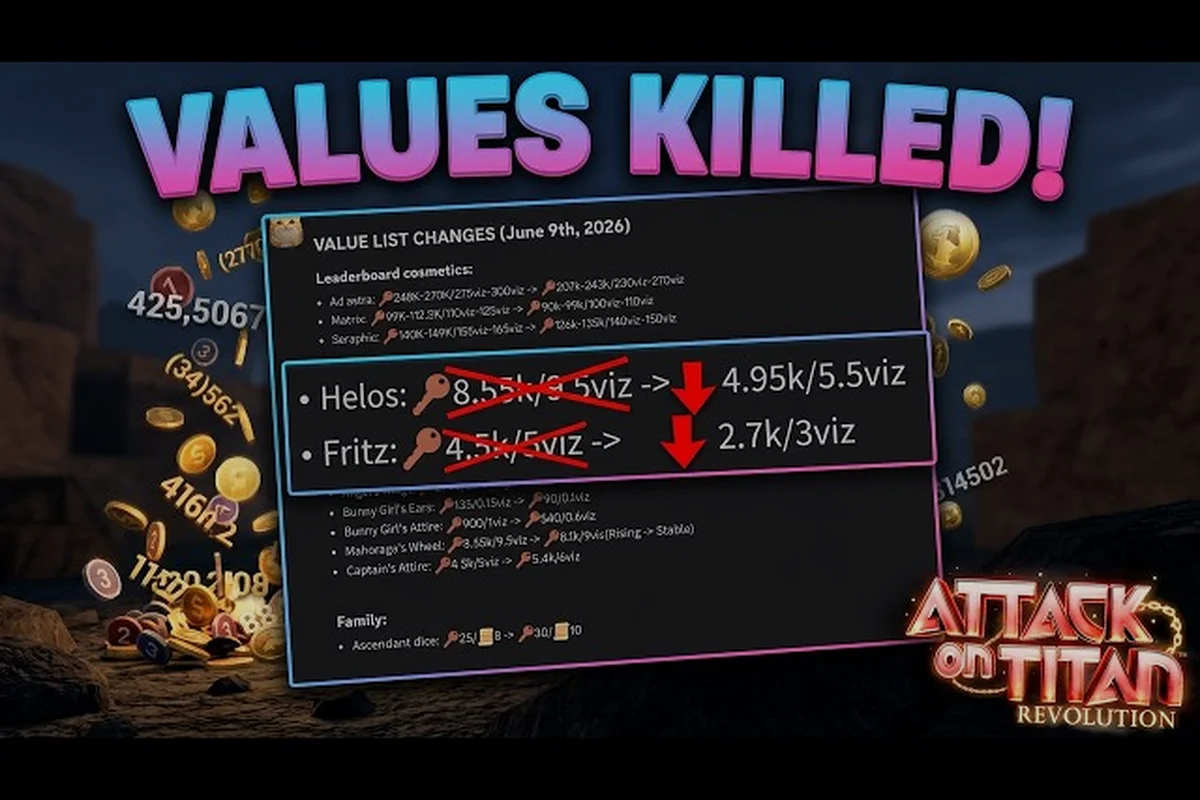
Attack on Titan Revolution value list decisions determine whether your account climbs efficiently or stalls. This guide ranks grades, families, perks, movement choices, and XP priorities using community-tested information so you can invest resources where they produce the strongest progression.
Value List: What Deserves Your Resources?
A useful Attack on Titan Revolution value list separates permanent account progress from temporary combat power. Families, family skills, grades, and repeatable XP gains deserve different ratings because their value compounds on different timelines: a strong family supports nearly every major activity, grades raise the combat ceiling, and dependable XP farming accelerates later rank-ups. For example, prioritizing XP for one mastery track may create more long-term value than diverting limited resources into a single spin reward, while family skill and grade upgrades can produce immediate benefits across missions and family matches.
When assigning value, compare each reward by its expected benefit per resource and how often that benefit can be reused. A family upgrade that improves the active skill across missions and Family Matches offers broader returns than a single-use spin reward, while grade progression increases the combat ceiling for repeatable missions. XP farming should also be measured against the next rank-up requirement, since dependable mastery XP can support every later unlock more efficiently than one isolated reward.
-
Family value: A strong family and its active skill improve nearly every major activity.
-
Grade value: Better grades improve the ceiling of your combat performance.
-
XP value: Reliable XP farming supports every later unlock and rank-up goal.
-
Movement value: Flashstep and Spins save time, but only rank highly when they do not replace essential combat upgrades.
-
Perk value: Perks are best evaluated by their active effect, rarity, and fit with your current family.
Treat a lucky spin as a bonus, not as reliable evidence of long-term value. For example, if a Spins reward performs well in one showcase mission but does not improve a family skill, grade progression, or repeatable mastery XP, it may not be worth the same investment as a permanent upgrade. Judge rewards by how consistently they contribute to missions, Family Matches, and rank-up goals, rather than by the excitement of one unusually strong pull.
Value tiers at a glance
| Value tier | What belongs here | Best use |
|---|---|---|
| S | Highest-impact family skills, foundational grades, dependable XP routes | Long-term account progression |
| A | Strong combat perks, useful mobility, efficient rank-up gear | Regular missions and family play |
| B | Situational gear, moderate XP gains, flexible extras | Filling a specific weakness |
| C | Low-impact rewards or slow resource sources | Saving for a guaranteed goal |
| D | Redundant upgrades or costly farming with poor returns | Avoid until requirements change |
These tiers are strategic rather than official game labels. They organize the Attack on Titan Revolution value list by practical returns: a family skill tied to core combat has more long-term value than a low-impact grade, while a reliable XP route can justify another spin even without a flashy combat perk. For example, prioritize Flashstep mobility and dependable family-play bonuses in the A tier, but move valuable rank-up grades to S when they support progression. At Prestige 5, compare the resource cost against the account gain before committing, since prestige resets can make an otherwise strong reward less efficient.
How to Rank Up Grade: A Practical Method
Improving your grade is a progression goal, so the Attack on Titan Revolution how to rank up grade process should begin with a stable combat baseline. Reaching a higher grade without improving fundamentals often creates a weak foundation that becomes expensive later.
Start by identifying the grade’s main benefit and the activity in which you plan to use it. Compare that benefit with your current equipment, then test the candidate in controlled missions. Community experience suggests that gradual upgrades are more reliable than replacing several pieces at once, because mixed gear can obscure which change produced the result.
Grade ranking checklist
| Grade trait | Practical value | Recommendation |
|---|---|---|
| Higher base stat | Raises performance across most activities | Prioritize when consistently used |
| Better secondary stat | Supports a specific build | Keep if that stat matches your play style |
| Minor improvement with limited use | Helps only in narrow situations | Delay unless resources are abundant |
| Excellent appearance but weak stats | Cosmetic value only | Equip for style, not optimization |
| Strong performance but hard to obtain | High long-term value | Prepare through repeatable farming |
The best upgrade is not automatically the one with the largest displayed number. For example, a grade with slightly higher Attack can outperform a higher-tier cosmetic option when your weakest gear slot is used for flashstep or spins, because those skills benefit from consistent base stats rather than a large headline value. If you are ranking equipment for prestige 5 preparation, compare the stat that actually changes during XP farming and prioritize a family skill that matches the mission’s difficulty instead of choosing by grade label alone.
When to spend and when to save
Save for a grade when your current setup reliably clears its intended content. Spend immediately when a new mission, family skill, or rank threshold makes the upgrade necessary. This prevents you from spending materials on an attractive but redundant increase and preserves resources for the grade that unlocks the next stage of progression. Your broader family choices also affect grade efficiency. If you are still deciding between major family rewards, the Mythic Family acquisition guide provides community-tested information about Yeager and other aspirational targets without presenting showcase results as official drop guarantees.
Prestige: Why Maximum Rank Is Not Automatically Best
Prestige is one of the most misunderstood parts of long-term progression. The Attack on Titan Revolution prestige system can reset or convert progress for a later reward, but the final tier should be reached only when its benefits outweigh the time needed to rebuild your setup.
Community reports place the current maximum at Prestige 5. Treat that as community-reported information rather than an official guarantee, because the game’s available content can change with updates. Before advancing, identify the exact reward, the reset cost, and whether your account can still complete essential XP stages afterward.
Prestige decision table
| Situation | Recommended action | Reason |
|---|---|---|
| Still learning core missions | Delay prestige | Rebuilding would consume too much time |
| One rank gives a needed power spike | Advance after testing | It improves the next progression loop |
| Farming resources are abundant | Consider the next rank | The reset cost becomes easier to cover |
| A family skill is still developing | Delay if possible | Preserve useful setup momentum |
| Prestige 5 is the current reported cap | Plan the final reset carefully | There is no verified higher tier to chase |
The key distinction is between prestige for a temporary boost and prestige for a permanent account milestone. A temporary boost may justify a reset only when you have a specific goal and enough resources to recover. A permanent reward deserves more planning because every reset should shorten a later grind rather than simply create another one.
Preparing for Attack on Titan Revolution Prestige 5
Treat Prestige 5 as a destination, not an automatic milestone. First secure a reliable XP farm, confirm that your family can still perform the required missions, and learn which items return after the reset. Save enough materials to rebuild immediately so that the prestige period does not become an extended waiting phase.
A player who enters a reset with a clear checklist will recover faster than one who prestige simply because a higher number looks impressive. That distinction is the core of a useful Attack on Titan Revolution value list: the largest reward is valuable only when the player can reach and use it efficiently.
XP Farm: Best Routes by Player Stage
XP farming should be treated as a repeatable engine, not a single hidden trick. A strong Attack on Titan Revolution XP farm depends on your current unlocks, survival time, and the amount of movement or combat complexity you can handle without losing progress.
New players benefit from simple routes that preserve momentum. Advanced players can use faster movement and denser encounters, but they should verify that speed does not reduce total rewards or create frequent restarts. If your account lacks strong movement choices, a basic farm may deliver more completed runs than a technically optimized route.
XP farm comparison
| Farm approach | Early game | Mid game | Late game | Main limitation |
|---|---|---|---|---|
| Simple repeatable missions | Excellent | Good | Average | Lower XP per run |
| Mission chains | Good | Excellent | Good | More setup time |
| Family match progression | Fair | Good | Excellent | Stronger accounts perform better |
| High-mobility farming | Fair | Good | Excellent | Requires Flashstep or Spins |
| Resource-targeted farming | Average | Good | Good | May optimize currency instead of XP |
The best route is the one you can complete repeatedly without avoidable mistakes. Measure completed runs and net XP over the same time window, because a difficult farm can look impressive in a single demonstration while producing fewer rewards per hour.
Making the farm more efficient
Upgrade survivability, movement, and mission familiarity in that order when early runs end prematurely. Survival creates more completed attempts; movement reduces wasted travel; familiarity helps you identify danger and collect rewards faster. The Artifact farming guide can improve collection efficiency if artifacts are part of your preferred route.
Do not ignore family match progression. It combines character growth with rewards, making it efficient when your family is strong enough to clear content consistently. If a route becomes stale, change one variable at a time—mission, route, movement loadout, or family setup—so you can identify the source of any gain.
Flashstep and Spins: Mobility Value Compared
Flashstep and Spins both affect how quickly you move through objectives, but their value depends on what you are trying to optimize. Flashstep is valuable for repositioning and maintaining engagement, while Spins can make circular movement patterns and repeated rotations easier to execute.
An Attack on Titan Revolution flashstep setup is strongest when it supports consistent positioning without interfering with your primary attack timing. An Attack on Titan Revolution spins setup is most useful when the movement pattern fits the route, preserves momentum, and avoids interrupting the windows in which you collect experience or combat rewards.
Mobility ranking guide
| Consideration | Flashstep | Spins |
|---|---|---|
| Quick repositioning | Higher value | Moderate value |
| Sustained circular routing | Moderate value | Higher value |
| Beginner reliability | Good with practice | Depends on route familiarity |
| XP-farm usefulness | Strong when movement is chaotic | Strong on circular routes |
| Upgrade priority | Before a high-skill route | Before requiring repeated spins |
| Common mistake | Activating too often | Losing rhythm and speed |
When mobility should outrank other upgrades
Prioritize mobility when travel takes up most of the run, missed objectives repeatedly restart the route, or your current skill set cannot safely maintain pressure. If you already complete missions quickly but lack damage or survivability, mobility may simply expose the next bottleneck without increasing your total rewards.
| Current bottleneck | Upgrade priority | Reason |
|---|---|---|
| Frequent deaths | Survivability | More successful runs matter most |
| Missed objectives | Flashstep | Repositioning reduces lost rewards |
| Slow circular route | Spins | Better rhythm lowers route time |
| Low damage | Combat grade | Mobility alone cannot finish enemies |
| Low XP despite fast runs | Mission or family setup | Speed is not producing value |
The practical conclusion is simple: treat Flashstep and Spins as multipliers rather than substitutes for core stats. They improve the quality of a solid route by enabling faster repositioning and smoother attacks, but they cannot compensate for insufficient combat grade, survivability, or mission progress. For example, if a run already clears objectives quickly but low damage causes repeated restarts, upgrading Flashstep will not raise total rewards; improving combat grade or the mission setup is the higher-priority investment in an Attack on Titan Revolution value list.
Spins: When to Keep Spinning and When to Stop
Spins create excitement because rare rewards can change a build instantly, yet expected value matters more than a recent lucky result. In an Attack on Titan Revolution spins plan, decide what the spin is intended to produce before you begin: family progress, a specific perk, grade materials, or general resources.
For targeted goals, keep spinning only when the pool or reward source matches that goal. For general resources, compare the expected use of every reward with the best alternative activity. A common-tier item may be worthless to you while remaining desirable to a new account, so the value list should reflect your inventory rather than an imaginary perfect player.
Spin decision checklist
| Goal | Continue spinning when | Stop when |
|---|---|---|
| Mythic-family goal | The pool can reward that family | The active pool cannot contribute |
| Perk completion | Missing perks match the current pool | Your remaining needs are in another pool |
| Grade upgrades | Materials translate into steady grade progress | Rewards are redundant or low-value |
| General resources | You need the resource category now | Stockpiling exceeds near-term goals |
| Luck farming | The gamble itself is the objective | The expected gain is negligible |
Community showcases are useful for learning what outcomes are possible, but they are not reliable probability samples. Community-reported figures include a Yeager chance of roughly 0.1 percent and a legendary clan chance around 0.5 percent in showcases. These are community-reported observations, not official drop rates, so they should guide caution rather than serve as guaranteed farming calculations. Luck-based systems also interact with the rest of your progression. The Luck and gems progression guide explains how resource choices can affect the pursuit of rare rewards without pretending that every lucky pull changes the account instantly.
Family, Perk, and Resource Priorities
Once grades, prestige, XP, and movement are covered, family and perk choices determine how well those investments work together. A strong family can make a moderate grade feel stronger, while a poorly matched perk can waste resources even when its rarity looks impressive.
Family and perk value table
| Reward type | Value condition | Lower-value condition |
|---|---|---|
| Family skill | Complements your main combat style | Duplicates a skill you already use |
| Divine perk | Community-tested effect fits the build | Showcase value exceeds actual use |
| Vessel perk | Supports a useful play pattern | Requires an unsuitable setup |
| Beast-related perk | Adds useful variety | Conflicts with your best rotation |
| Common or rare perk | Fills a real stat gap | Chosen only because it is new |
| Legendary family | Strong long-term foundation | Hunted without a viable resource plan |
Community-tested showcases support the existence of Divine perk, Vessel, and Beast Titan-related unlock content, but these details are not confirmed in official patch notes. Treat them as progression possibilities worth testing rather than guaranteed milestones. For example, a Divine perk should outrank a Common or rare perk only if its showcase value translates into a practical combat benefit, while a Vessel unlock is more valuable when it fits a usable play pattern instead of requiring an unsuitable setup. Until official values, unlock requirements, or patch-note data appear, check the perk’s effect against your build and avoid planning a prestige 5 path around unconfirmed Beast Titan progression.
Resource allocation order
-
Secure a family or perk that removes a major weakness.
-
Improve survivability if completed runs are your limiting factor.
-
Invest in movement when route efficiency visibly limits XP.
-
Upgrade grades after the combat foundation is stable.
-
Save prestige materials for a planned reset rather than spending them casually.
The Common Perks guide can help identify whether a lower-rarity perk solves a more immediate problem than saving for a prestige reward. Remember that resources have different scarcity levels: spare gems may be common, while a specific family or grade-upgrade path can demand far more effort.
A Complete Value List Decision Framework
Use this Attack on Titan Revolution value list as a sequence of decisions rather than a static ranking. Begin with your account’s bottleneck, compare the reward against the upgrade you can obtain next, and then test the change in repeatable conditions. This method accounts for account age, available unlocks, and resource reserves without pretending every player has the same needs.
| Your main goal | Highest-value target | Secondary target | Lowest priority |
|---|---|---|---|
| Reach a better grade | Required stat improvements | Combat-grade materials | Cosmetic items |
| Farm more XP | Reliable mission route | Movement and survivability | Slow resource targets |
| Prepare for prestige | Permanent reward path | Rebuild materials | Unneeded duplicates |
| Obtain a rare family | Matching spin pool | Long-term resource reserve | Off-target rewards |
| Improve survivability | Relevant defensive perk | Family synergy | Minor stat extras |
| Complete content faster | Flashstep or Spins | Mission familiarity | Over-upgraded combat gear |
Before committing resources, complete a short test with a consistent rule. Record the mission, time spent, success rate, XP earned, and material gain. Repeat it under the same conditions after changing one part of the loadout. This small measurement habit prevents costly “upgrades” that look strong but do not improve actual progression.
Final checklist before spending
-
Family fit: Does the family improve the activities you complete most?
-
Grade fit: Is the upgrade needed for a current mission or rank threshold?
-
XP return: Does the route finish reliably and produce measurable XP?
-
Mobility fit: Will Flashstep or Spins improve the route without disrupting it?
-
Prestige timing: Do you understand the reset and have enough resources to rebuild?
-
Spin purpose: Is this pool targeting a real need, or are you buying random hope?
-
Resource depth: Are you preserving enough currency for a guaranteed upgrade?
Frequently Asked Questions
What is the best strategy for an Attack on Titan Revolution value list?
Build around your account’s biggest bottleneck rather than copying a universal ranking. Prioritize a useful family or perk, improve survivability and grade only when missions demand them, and reserve prestige or rare-family attempts for targeted goals. This produces better returns than spending randomly across every reward category.
How do I reach Attack on Titan Revolution Prestige 5 efficiently?
Prepare a rebuild plan before making the reset, including required grades, family setup, and XP route. Save enough materials to return to your target mission quickly, and confirm what resets. Community reports identify Prestige 5 as the maximum, but the exact requirements may change with updates.
Is Flashstep better than Spins for XP farming?
Flashstep is generally better for rapid repositioning, while Spins fit circular routes and repeated rotations. Compare completed runs over equal time periods rather than judging by movement speed alone. The better option is the one that reaches objectives, survives encounters, and preserves reward collection without frequent restarts.
Should players keep spinning after reaching a high tier?
Stop when the active pool no longer supports your selected goal or when rewards become redundant. Community-reported showcase rates are too limited to serve as guaranteed probabilities, so treat rare drops as uncertain. Save spins for a clearly defined target and avoid spending your reserve on generic randomness.
What is the fastest way to build an XP farm?
Begin with missions you can clear consistently, then improve the factors causing slow or failed runs. Add movement when travel is the main delay and survivability when deaths end attempts. Track results across several runs, because the most efficient farm is the one that produces repeatable net XP rather than a single impressive completion.