
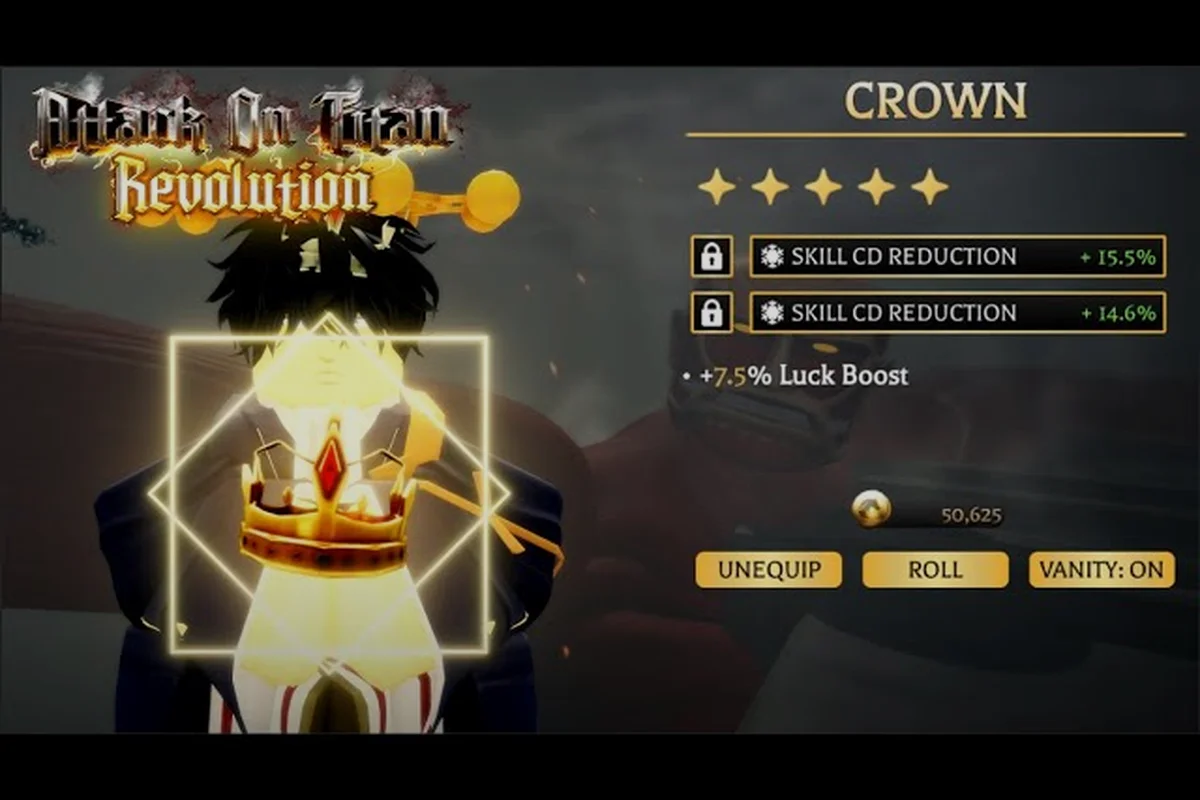
Attack on Titan Revolution artifact farming matters because each equippable modifier comes from specific content rather than a generic random chest. The right route, luck conditions, and farm target can turn a long grind into a focused hunt for the Crown Artifact.
Artifact Farming Overview
Artifact farming is most efficient when players separate three ideas: where an artifact can drop, how many attempts the route needs, and whether the result improves the current build. The official Attack on Titan Revolution Roblox group describes artifact runs as content-specific, while community showcases suggest that some items are treated as dedicated targets rather than hoped-for random bonuses.
That distinction changes the routine. Random farming keeps every usable modifier, while target farming prioritizes one effect and ignores most ordinary rewards. For a new account, a broad route is useful for learning the systems and filling empty slots. For a developed account, the Crown-specific route is much more efficient because every attempt has a defined purpose.
| Farming goal | Best approach | Main benefit | Main limitation |
|---|---|---|---|
| Fill empty artifact slots | Broad content route | Collects several usable modifiers | No guarantee of the wanted item |
| Hunt the Crown Artifact | Dedicated Crown route | Converts attempts into targeted progress | Fewer unrelated rewards |
| Finish Update 4 collection | Rotating artifact route | Covers the newer reward pool | Requires route changes by target |
| Improve an existing build | Focused effect route | Tests a useful slot combination | Still depends on obtainable drops |
Update 4 Artifact Context
Update 4 added a new artifact set that remains part of the current pool, as documented in the Update 4 artifact guide by JustBOZ. Because these rewards use distinct effects rather than simply larger stat lines, players should identify the missing effect before repeating missions. A reliable approach is to keep three records: current equipped artifacts, empty slots, and priority effects. The broader new artifacts overview can help distinguish cosmetic rarity from practical value, while this guide focuses on the acquisition route.
| Collection need | Correct action | Why it works |
|---|---|---|
| No artifact in one slot | Farm broadly until that slot receives a modifier | Progress remains useful even without a rare drop |
| One specific effect missing | Repeat the associated content route | Keeps each attempt relevant |
| Crown not owned | Use the dedicated Crown route | Avoids spending time on unrelated rewards |
| Several Update 4 effects needed | Rotate among their respective activities | Broadens coverage across the newer set |
Set a Realistic Expectation
Artifacts are chance-based rewards, so a single successful run is not a basis for promising a fixed drop rate. The research available for this guide does not establish an official percentage for every artifact. Instead, players should use observed results from their own account and community reports while keeping the sample size visible.
For example, if the Crown appears after 40 recorded attempts, that does not prove a permanent 1-in-40 rate. It establishes a personal observation: 40 attempts without a Crown, followed by one result. Record each attempt, source, result, and account state so the pattern can be compared later.
Artifact Farming Routes and Drop Chances
Artifact farming routes should follow the content that can award the desired item rather than relying on a generic “best mission” recommendation. This matters because each run has a known purpose, and the player can stop or change routes without wasting completed activity time.
The community route information identifies a practical split between artifact runs, memory sessions, and vessel progression. Only the artifact portion belongs in this guide; memory rolls and vessel unlocks are separate progression systems and should not be presented as interchangeable artifact sources.
| Route type | Best use | What to track | Expected practical result |
|---|---|---|---|
| Artifact activity route | Direct artifact attempts | Mission completions and rewards | Regular targeted progress |
| Update 4 rotation | Collecting newer modifiers | Which effects appeared | Gradual set completion |
| Crown route | Hunting one premium item | Attempts per Crown | Rare, purpose-built progression |
| Broad farm | Filling early slots | Total usable drops | Faster early collection |
Building an Artifact Farming Route
Start with one empty slot or one missing effect. Do not begin by listing every artifact in the game, because that turns a focused session into an unpredictable checklist. The target-first loop is more effective: select the desired modifier, identify its eligible route, run that content, record the result, and repeat only when the reward remains useful.
A practical route sheet should include the current objective, the number of completed attempts, whether any effect was obtained, and the next action. This approach also makes it easier to compare a successful evening with an unlucky one without relying on memory.
| Session stage | Player action | Artifact gained | Next decision |
|---|---|---|---|
| Preparation | Review empty slots and priorities | None | Select one specific target |
| First route | Complete the eligible content | Modifier or no modifier | Keep the useful drop, then repeat |
| Secondary route | Rotate to another content source | Different effect | Equip if it fills a gap |
| Target push | Continue the dedicated route | Crown or other goal | Stop after the target drops |
| Review | Compare inventory and build | No new drop | Update records and targets |
Understanding Artifact Drop Rate Evidence
A published artifact drop rate is not available in the supplied official or community evidence, and inventing one would make a guide less useful. Players often discuss artifact chances based on a series of completed runs, but those observations can be affected by the route, update version, account progress, and whether the target was tied to a dedicated reward.
Use percentages only when the numerator and denominator are clear. “I got 2 Crowns in 100 attempts” is a 2% personal sample, while “the Crown has a 2% chance” is a stronger claim that requires authoritative confirmation. This distinction keeps community observations useful without presenting them as official probabilities.
| Claim type | Evidence needed | How to record it |
|---|---|---|
| Personal sample | Attempts and successful drops | Source, count, result, date |
| Community observation | Several reported samples | Player report and test conditions |
| Guaranteed source | Confirmed reward description | Quote the relevant reward wording |
| Official percentage | Developer documentation | Record version and source |
Why the Crown Is a Dedicated Target
The Crown is commonly approached as its own farming target instead of one item within a generic pool. A verified Update 4 artifact gameplay guide describes the new artifact effects and emphasizes the collection goal, while community discussions treat the Crown as a dedicated farm.
This distinction does not create a guaranteed path. It simply means the route is chosen for the Crown rather than for general equipment. Players should continue saving compatible rewards during the hunt, but avoid distracting themselves with unrelated upgrades that consume the same limited resources.
Practical Attack on Titan Revolution Artifact Farming Routine
A successful Attack on Titan Revolution artifact-farming routine divides each session into preparation, execution, and review. Before entering combat, record the target material, map region, and objective—gathering, crafting, or searching for a Crown Artifact—then review the results after the run. Because artifact drops are chance-based, this structure prevents a failed drop from wasting the entire session and makes the remaining artifact drop-rate test more efficient.
Prepare the Session
Check which artifact slots are empty and which current effects conflict with the desired build. Then select a route that can produce the missing effect. The artifact quest guide is useful for understanding upgrade and reward progression before committing to a long hunt.
Preparation checklist: Before farming an Attack on Titan Revolution artifact, verify the relevant quest conditions and reward tiers in the artifact quest guide, since a route can offer a different artifact or upgrade path depending on the update. For example, when pursuing the Crown artifact, confirm that the required quest chain and attempt count are active before spending materials on repeated runs. This prevents wasting artifact drop chances on a target that cannot appear from the selected route.
-
Confirm the current target effect.
-
Note the number of available artifact slots.
-
Compare the target with equipped modifiers.
-
Choose the route tied to the target.
-
Record the starting attempt count.
-
Keep lesser rewards only when they improve the build.
Execute Without Wasting Drops
Equip an immediately useful reward even when it is not the target. A broad farm still produces progression, and a secondary artifact can prevent wasted resource income. The key is to reserve rare materials only when a reward clearly contributes to the active objective.
For builds centered on mobility or shifter performance, compare the new modifier with the guidance in the best artifact guide for Shifters. That comparison should decide whether the drop is an upgrade, a sidegrade, or an item for another save.
| Reward quality | Immediate decision | Long-term use |
|---|---|---|
| Fills an empty slot | Equip it | Strong early-game gain |
| Upgrades an existing effect | Equip if stronger | Reduce future material needs |
| Matches a planned build | Equip it | Support a focused specialization |
| Duplicates a weaker effect | Save or replace selectively | Avoid taking every duplicate |
| Does not improve the build | Keep only if scarce | Do not let it derail the target farm |
Record Every Attempt
A precise log makes artifact-farming data more useful than relying on memory, especially when comparing a specific route with another after the update 4 artifact changes. For each attempt, record the route, attempt number, received artifact, and whether it was equipped. For example, log “attempt 18—no artifact” alongside later attack bonus modifier drops; excluding misses inflates the apparent artifact drop rate and hides whether a route is genuinely efficient for obtaining a crown artifact.
| Log field | Example | Why it matters |
|---|---|---|
| Route | Crown-specific activity | Controls for source |
| Attempt number | 18 | Shows personal progression |
| Result | No artifact | Prevents favorable-sample bias |
| Reward | Attack bonus modifier | Identifies the usable drop |
| Decision | Equip in open slot | Records the practical outcome |
How to Get the Crown Artifact Efficiently
Players asking how to get the Crown need a focused plan rather than a promise that one mission always works. The available evidence supports treating it as a dedicated farm, but it does not publish a universal percentage or guarantee a fixed completion count.
Select the Crown Route
Choose the content identified by current community gameplay as the Crown’s dedicated source. Confirm the route against the current Update 4 guide and the game interface before beginning, because reward labels can change between patches. The Attack on Titan Revolution artifact and memory farming group page is a useful reference for route discussions because artifact runs are tied to their corresponding mode.
Decide What Stops the Session
A good stopping rule keeps Attack on Titan Revolution artifact farming from becoming an open-ended grind, especially when drop rates vary between runs. Set the endpoint before hunting: obtain the Crown Artifact, reach a fixed attempt count, spend all available materials, or pause once another gear upgrade becomes more valuable. For example, stop after 10 failed runs if the targeted artifact has not dropped, then use those materials toward a stronger weapon or equipment roll instead of continuing to chase the same reward.
| Limit type | Best for | Benefit |
|---|---|---|
| Target acquired | Confirmed Crown hunters | Ends the session immediately |
| Attempt cap | Players managing time | Creates a predictable endpoint |
| Resource limit | Players saving for upgrades | Prevents overfarming |
| Build completion | New accounts | Balances collection with progression |
Avoid These Common Mistakes
The most common mistake is treating a community sample as an official drop rate. Another is switching between unrelated routes after every attempt, which makes it impossible to estimate progress. Players also sometimes equip every reward automatically, including duplicates that do not improve the current build.
A fourth mistake is farming the Crown while ignoring inexpensive improvements that accelerate the account. Compare the cost of artifact farming with the materials needed for prestige, and review the prestige guide when deciding whether long-term progression should take priority.
Update 4 Artifact Farming Priorities
Update 4 artifact farming works best when players separate collection completeness from build quality, because filling every missing slot can weaken a specialized loadout. For example, a damage-focused account may prioritize attack-compatible gear and strong sub-stat rolls, while a support build should reserve slots for assists or team-buff effects instead of forcing an artifact merely because it completes the set. Newly acquired modifiers should also be evaluated against existing options: a rare bonus can still be the inferior choice if its main stat conflicts with the build’s damage, sustain, or troop-role requirements. Artifact drop chances and route efficiency determine how quickly options are obtained, but they should not dictate which pieces are equipped. A practical approach is to farm until each priority category has multiple usable candidates, compare the artifact’s main stat and sub-stats, then upgrade only the pieces that improve the intended combat performance.
Prioritize Empty Slots
An empty artifact slot provides immediate value because any compatible modifier improves the active setup. If the player has several empty slots, broad farming may be more productive than a single-target push even when the Crown remains the ultimate goal.
Prioritize Effect Synergy
Artifacts apply modifiers rather than simple flat stat increases, so their value depends on the build. A speed modifier may be excellent for one play style and redundant for another. Compare the proposed effect with the current gear, memory choices, and preferred combat behavior.
| Player situation | Priority | Suggested approach |
|---|---|---|
| Early account | Empty slots | Use broad artifact content |
| Mid-level account | One missing effect | Use its associated route |
| Crown hunter | Crown target | Run the dedicated route |
| End-game collector | Missing Update 4 effects | Rotate among targeted activities |
| Resource-limited player | Build improvement | Farm only when rewards are usable |
Track Update Changes
The artifact pool can change as new updates arrive, and later guides may cover different systems. The Update 5 overview is separate from the verified Update 4 artifact information here, so players should not assume that a community showcase from another update proves the current reward rules.
| Version state | Farming decision | Reason |
|---|---|---|
| Current Update 4 set | Follow verified Update 4 routes | Matches the documented pool |
| Newer content available | Verify route labels before farming | Avoids carrying forward outdated assumptions |
| Patch changes rewards | Restart the personal log | Establishes a new sample |
| Unconfirmed feature shown | Wait for playable confirmation | Trailer footage may precede release |
Advanced Artifact Session Efficiency
Advanced efficiency in Attack on Titan Revolution artifact farming comes from reducing decision time, preserving every reward, and measuring results without treating a limited sample as an exact artifact drop rate. During a long Crown hunt, consistent target selection and a clear session log make each run useful progress; for example, recording Crown attempts, completed hunts, and artifact drops by location helps separate genuine farming trends from normal short-term RNG, especially when evaluating the Crown artifact and Update 4 artifacts.
Batch Route Decisions
Choose the route once at the start of a session and complete a defined number of attempts before switching. Switching immediately after a miss can prevent enough attempts to reveal whether the route is producing any results. When time is short, complete the available run and review before selecting the next target.
Protect Rare Materials
Do not consume materials intended for a future upgrade unless the current reward has a clear, immediate purpose. A surplus common artifact may be worth sacrificing, but a rare modifier should remain available for the build that can use it properly.
Compare Sessions Instead of Individual Misses
A single missed artifact drop says little, while twenty tracked attempts can reveal whether a farming route is actually productive. For each Attack on Titan Revolution session, record the route, total artifact attempts, useful drops, and time spent; for example, 20 attempts yielding 6 useful drops is more informative than one lucky crown artifact drop. Comparing sessions exposes inefficient routes and wasted farming time without treating a small personal sample as an official artifact drop rate or guaranteed drop chance.
| Metric | Calculation | Use |
|---|---|---|
| Usable-drop rate | Useful drops divided by attempts | Measures collection efficiency |
| Target rate | Targets divided by attempts | Tracks one objective |
| Time efficiency | Useful drops divided by time spent | Identifies costly routes |
| Inventory growth | New equipped modifiers | Shows build progress |
Know When to Farm Artifacts and When to Move On
Artifact grinding is not automatically the best use of every session. If an upgrade, story objective, or account milestone offers more value, complete that first and return with a clear target. The optimal route is the one that produces useful progress while respecting the player’s time and resources.
Frequently Asked Questions
What is the best artifact farming route in Attack on Titan Revolution?
The best route depends on the reward you need. Use the activity tied to your target artifact, farm broadly when filling empty slots, and dedicate a session to the Crown when pursuing that specific collectible. Since published sources do not confirm one universal route for every artifact, verify the reward label against the current game version before committing time.
How do players get the Crown Artifact in Attack on Titan Revolution?
Players should use the dedicated Crown farming content identified by current community guides, complete the activity, and check the reward screen after each run. The available evidence supports a targeted Crown farm, but it does not establish a guaranteed number of attempts or an official percentage. Record every attempt, including misses, to track personal progress accurately.
What is the artifact drop rate in Attack on Titan Revolution?
No official percentage for every artifact is confirmed in the available sources, so claiming one would be misleading. Players can calculate a personal sample by dividing successful drops by completed attempts on the same route. Keep the date, game version, route, and reward records together because community-reported chances may change when the artifact pool or reward system is updated.
Are Update 4 artifacts available through the same farming activities?
Update 4 introduced a new artifact set that remains part of the current pool, but availability can still depend on the specific content that awards it. Check the reward description shown by the game and consult a current Update 4 artifact guide before starting. This prevents a general artifact run from being mistaken for a targeted route when the goal is a particular new modifier.
Should players equip every artifact found while farming?
No. Equipping every drop can dilute a focused build and consume materials needed for better upgrades. Keep a reward when it fills an empty slot, replaces a weaker effect, or supports a planned specialization. Save valuable duplicates for comparison, and preserve rare materials when the artifact does not improve the active setup.